We’ve talked about the importance of brand identity (and if you missed the blog on this last week, go here), but that’s just the start. Apply the same thinking to sections too. The more you do this, the more likely you are to win with your audience.
Sections as minibrands: go niche and win
Oct. 16, 2026 by Em Kuntze
The assertion
Your brand should have its own specific identity - but each of the sections you ‘own’ should as well.
There are riches in niches, but only if those niches are clearly defined.
Let’s work with the data from a news site and see how to do this.
For the sake of argument let’s call it The Nijmegen Oracle.
Why are you using a fictionalised news brand here?
Yes, real-world examples and client cases are always preferable. It’s good to show how things work in reality.
However, when it comes to strategic development, it’s understandable that newsrooms won’t want to share their perspectives and processes.
Because we wouldn’t want to show data from an actual client, we’ve captured the broad findings we often see in order to show you how this process might work for you.

Let’s imagine we’ve identified its beating heart/ its DNA already:
Nijmegen Oracle — Where the city becomes yours.
Value proposition:
Nijmegen Oracle brings young people the city’s most personal, vibrant and useful stories — told by credible local voices who know the scene, the people and the places. We help you discover what Nijmegen has to offer, and where you fit in.
Once you’ve identified the central brand DNA we’ll next look at the current performance of its sections.
For this we’ll track the number of articles published, against key engagement metrics, across user needs for each section by generating a report of recent performance. This is usually three months; it could be longer.
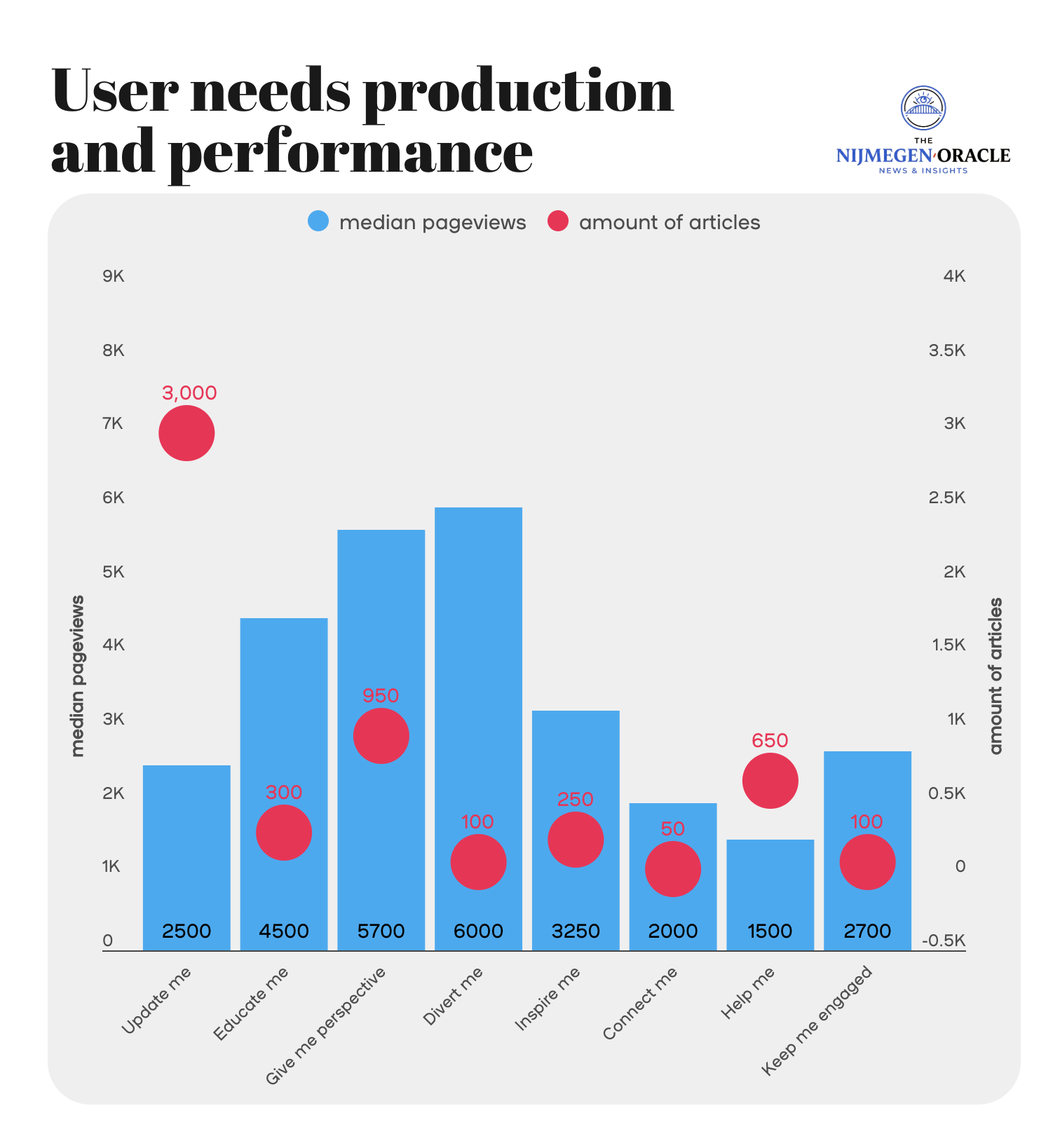
One of the most useful reports for clients is a visualisation of the relationship between the number of articles produced - and the response of the audience. To give this some nuance, we group articles into the 8 universal user needs for news, so it’s easy to see at a glance what’s working, what’s not, and what’s off balance.
Graph notes:
- The bar shows the number of articles published in each of the 8 user needs
- Dots represent audience attention (median page views)
The rule of thumb
Dots should sit above bars because we want to see articles working hard for themselves and delivering value. We don’t want to see more articles being produced than read. We also can recognise areas of untapped potential where article engagement is much, much higher than relative production, suggesting that there’s appetite for more of a certain thing.
At Nijmegen Oracle the Business section is showing a reassuring balance between content production and content engagement.
Leisure has room for improvement, but on the whole is positive.
The Sports section illustrates something we see often: an over production of a single type of content to no demonstrable benefit.
For each of these three sections there are simple steps you can take now - once you’ve got a snapshot of where you are, you’re off.
Here's the results, what they mean - and Rutger's suggestions for what the Njimegen Oracle team could do about it.
What’s happening in the business section
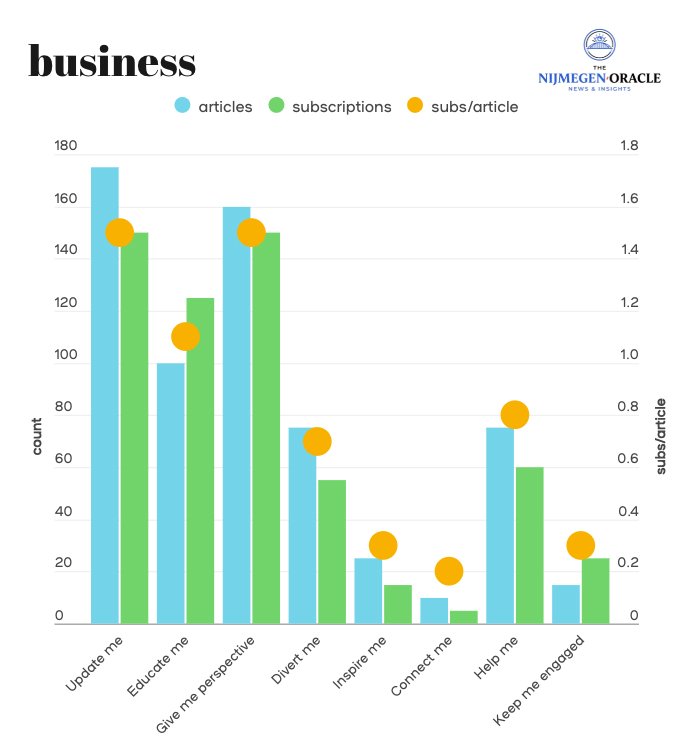
There’s a comforting symmetry between the kinds of articles being published and what the audience are actually looking at. The business section has positioned itself as prioritising explainers and contextual-based content - and what’s being produced broadly in line with audience appetite.
The news site itself may have a unique perspective, so the first question should always be: how can this manifest in each section? If you claim to be bringing context and perspective to city life, you shouldn’t then be publishing large quantities of fact-based breaking news. You also don’t want to be trying to do everything. Owning a niche means finding a perspective - and sticking to it. Marry that with distinctive formats and you’re onto a winner. We can apply the same kind of thinking we did to create the whole-brand value proposition to each section as well”

Rutger Verhoeven CRO, smartocto
So, for the business niche, the response to that prompt might be:
WHAT: Nijmegen Oracle connects young, curious graduates professionals with the world of business in the city in a way that’s exciting and inspirational.
WHY: They do it to inspire our next generation of business leaders and thinkers - and to help them feel that this city has a reason for them to stay, and ways for them to contribute.
HOW: They execute this by tapping into the knowledge of people just a little older and with more experience
DEFINE THE NICHE
“Insights into local business from experts in the field”
OWN FORMATS
- Even without doing anything the data shows the audience favours expert/ insider analysis. Consider putting a face to certain regular features: you’ll be able to provide the updates, but also give an assessment from an expert
- ‘Educate me’ type articles show they’re not only well read - they drive subscriptions. Broaden platforms for this key content area - podcasts, for example? Or what about a newsletter on Business related topics only. It will be attractive to (local) advertisers for sure. Different ways of communicating key facets of this kind of content can be effective: think infographics that people come to recognise as being unique to you (much like the graphs we’ve shared above are key to us).
OWN TIMING
- We don’t have the data here, but it’s worth checking to see if there are any patterns in the time news is consumed. For example, high engagement during peak rush hour might suggest that people are reading on the commute and, this being the case, will need content that’s consumable for this window of time: audio/ podcasts are hands free - video might be tricky (and if you do provide it with subtitles and start w/ sound off). Longer pieces (whether written or spoken) might do well here; so too might morning briefings.
- How about end of day summaries and reflective pieces?
What's happening in the Leisure section
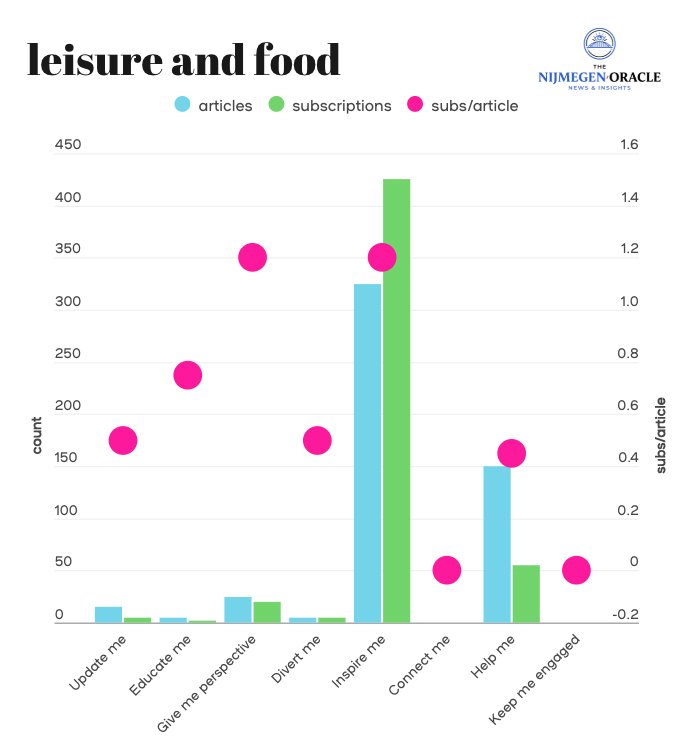
While there’s no huge negative here (unlike the sports section, which we'll get to in a moment, they aren’t producing unread articles), there is untapped potential - and moreover an opportunity to own the niche in a more assertive way.
This is a great example of how really honing the definition for your sections can help trigger more thoughtful, more relevant, more exciting content. So start there: define the niche to own the niche. This gives your editorial team clarity about what to commission, write and publish - and gives the audience clarity about what to expect from you. This is what I’d suggest, for example:
Rutger Verhoeven CRO, smartocto
DEFINE THE NICHE
Instead of just 'leisure', get specific and reveal your promise. The following says a whole lot more about who you are to your audience
“What’s going on, Nijmegen?” Discover where Nijmegen comes to live.
- mini-explainers
- hidden gems
- day plans
- honest recommendations for eating, drinking, going out and making the most of the city
Brought to you in formats like “5 hidden spots in the old city”, “Where to go on a rainy Tuesday”, “Best terrace for sunset” and “What’s actually worth the hype?”
There’s loads of potential here, but the majority of the articles fall into two areas: ‘Inspire me’ and ‘Help me’. The top three user needs (that convert to subscribers) here are ‘Inspire me’, ‘Educate me’ and ‘Give me Perspective’. Where’s the sweet spot?
We’d suggest shifting focus to give a resident-owned view of leisure and food in the area.
OWN FORMATS
- “Nijmegen Locals” a feature where interviews become more interactive and end with the interviewee recommending the next chef/ artist/ musician etc person to speak to. Chains content together, highlights events, places and spaces and puts ‘local heroes’ at the centre of the section. Feels much more immersive.
- Your weekend, sorted - what’s on, where, and why you’ll miss out if you don’t go.
OWN TIMING
- Events calendars - openings, highlights, festivals
- This Weekend - what’s on now. Ties to action-driven content, stays relevant, can be bookmarked to highlight what’s on for the days off.
What's happening in the sports section?
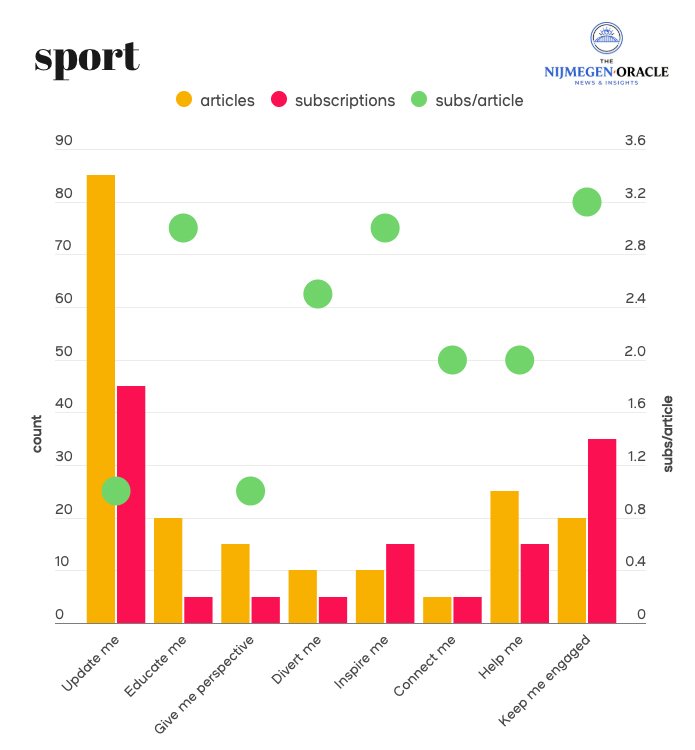
And here's the section likely to make for an uncomfortable conversation.
Too many update type articles, which aren’t being read.
The audience is signalling they’re interested in context and analysis - as well as helpful, action-driven content - but they're not getting it.
Far from being awkward, we actually find these kinds of reports motivational: these results are actually incredibly common.
Here's the thing: this kind of balance isn't unusual, but being the newsroom to actively address them is. This is a gift. Here's what you could do about it.
What’s exciting about this report is that it shows a clear opportunity to own a niche. Not much about this section is ideal. There’s great engagement for inspirational, engaging content - but there’s just not much of it. Update me articles are clearly where the editorial priorities lie, but readers seem much less interested. This is a signal to completely rethink the approach to covering sport.
Rutger Verhoeven CRO, smartocto
DEFINE THE NICHE
“We love local sport”
Make the city move. Cheer with the city.
Your guide to being active and being a fan in Nijmegen — from trail runs, mountain biking and wild swimming to matchdays, fan culture and the city’s biggest sporting nights.
- Active city: running routes, mountain biking, swimming in the old river, gyms, clubs, outdoor sport and ways to get moving.
- Fan city: Nijmegen’s famous soccer and ice hockey culture, matchdays, supporters, rivalries, stadium atmosphere and local teams.
- Where the two meet: events, challenges, community sport, and the people who make Nijmegen a sporting city.
Update me articles certainly have their place, but it’s not here. Given that the Nijmegen Oracle - as a regional newsroom - has no need to cover national, top league or international sports - it should use its position in the heart of this particular city to its advantage and place itself as cheerleader and champion of local teams. The remit here should be to boost morale and love for the local sides, and build momentum around sporting events that have a clear geographical tie to the city itself.
OWN FORMATS
- “Our man on the ground” - if you’re going to do Update me reporting, take advantage of the fact you’re in the same locale as the events themselves and report directly from the arena, using video and audio. Interview fans, communicate the atmosphere.
- Player profiles - grow the feeling of connection between community and club(s) by profiling players with more informal, human-centric articles, interviews and behind the scenes reporting.
- Crowd-sourced coverage - video coverage of match highlights - get the fan base actively engaged.
OWN TIMING
- Work around sports schedules - these are available in advance!
- More in-depth, longer coverage on non-sports days; shorter, more emotive pieces closer to matches/ events.
Great news! Next week we’re turning our attention to User Needs for Sports! We launched this earlier in the year, and we’re excited to show you how getting niche-y with user needs can yield huge rewards! >>>
Last thoughts, briefly
Editorial analytics often make for uncomfortable reading. These charts above certainly would. No one wants to see (or be told) that their news site is falling short.
So yes, being told the kinds of things we’ve highlighted above will be hard to hear.
But here’s the thing.
Most newsrooms we talk to face reports similar-ish to those above. The ones that use those less-than-ideal findings as ‘a springboard to better’, are the ones who start owning their niche, seeing improvements in key metrics and are best placed to future proof themself.
So ask the hard questions. Make sure you pay particularly close attention when the answers are hard to hear, and address those shortcomings one at a time.
Many don’t. If you do, you’ll fly.

