Here’s the problem.
AI won’t save a weak brand. It will expose any shortcomings. Only sharply defined brands can hope to compete, foster loyalty and go places in the age of AI.
Oct. 8, 2026 by Em Kuntze
Here’s the problem.
AI won’t save a weak brand. It will expose any shortcomings. Only sharply defined brands can hope to compete, foster loyalty and go places in the age of AI.
“AI doesn't expose weak brands by accident - you reap what you sow. In the past, when audiences had fewer alternatives, a vaguely defined media brand could survive simply on habit and availability. Yes, it might not be great, but it's there, sort of a thing. Now we have AI-mediated access to information. So the only question that will differentiate good from average is the question of distinctiveness. What is your balance between commodity and original content? What does this publisher do that no one can replicate? It goes back to the main question - what will change in your audience's lives if your media brand disappears tomorrow?”

Dmitry Shishkin Independent Digital Media Consultant
(the bit that makes for hard reading)
1.Your top stories could be published by 10 other outlets without anyone realising it comes from you.
TEST: if you removed the masthead or visual branding from this article, would it be easy to identify it as one of yours?
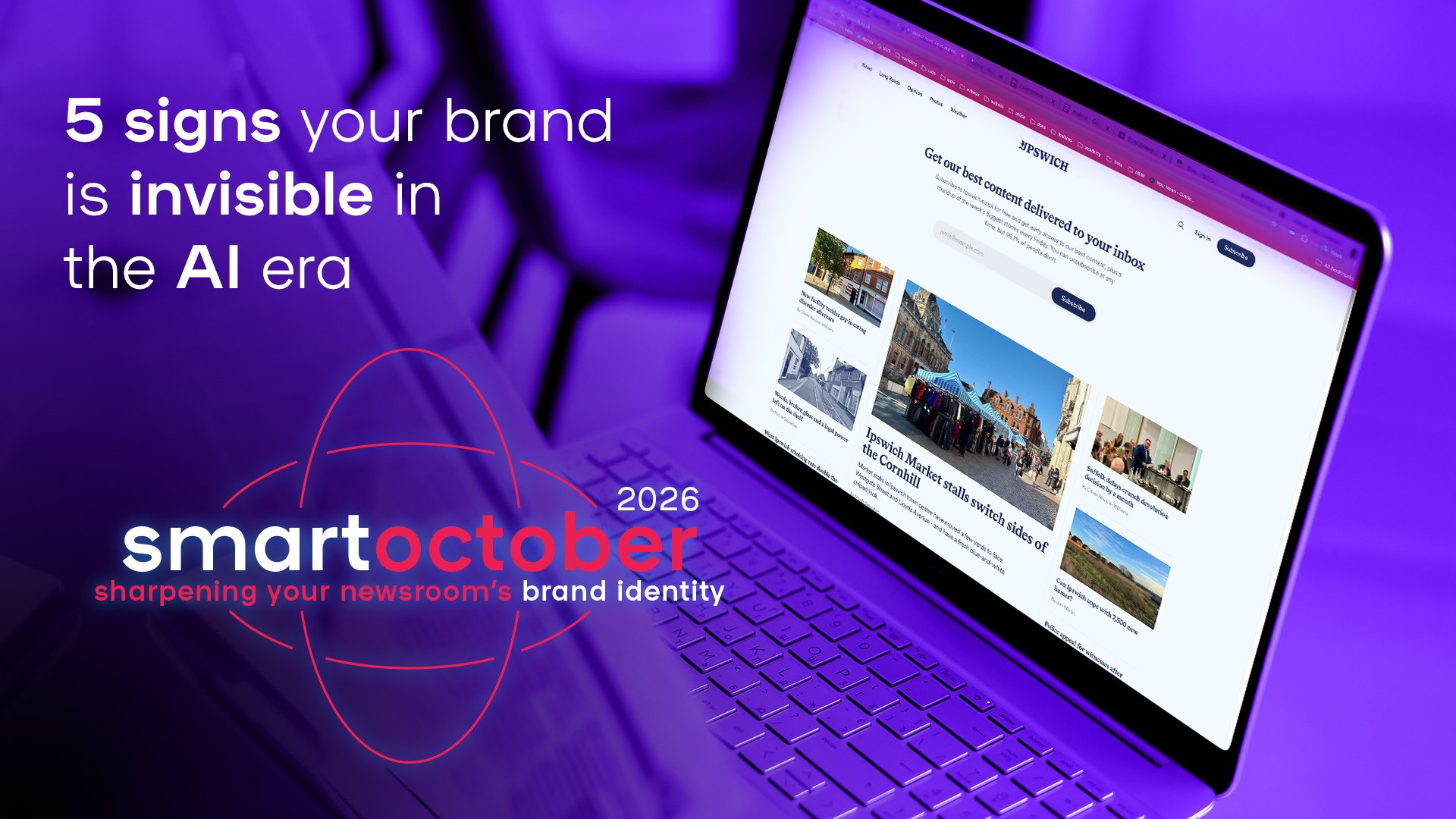
EXAMPLE: Ipswich.co.uk - a hyper-local news site, based in the East of the UK - deployed an Axios-style to their reporting. It’s simple, it’s clear and it’s distinctive - especially when it’s coupled with their mission/ brand.
TEST: do a count of news media cliches. Deduct a point for the use of ‘trustworthy’, ‘independent’, ‘innovative’ etc. What newsroom doesn’t want to be any of those things? What’s your *actual* point of difference?
TEST: see point one. How do you bring the news to your audience? What’s your approach?
EXAMPLE: Delayed Gratification literally wrote the book on infographics for news. Theirs is an extremely strong tagline (Last to breaking news) paired with an extremely distinctive visual identity (colour palette, infographics).
TEST: if your newsroom disappeared tomorrow, would anyone actually miss it? Sounds harsh, but it’s an important question. Of course people should! But the reason they would miss it is because you do something, give something, show something that no one else does - or can.
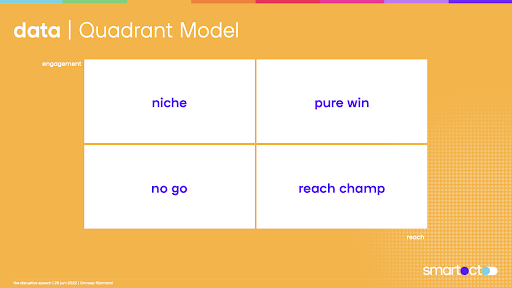
TEST: Have a look at this visualisation we use. This quadrant model tracks engagement and exposure. Where both are high, we call it a ‘pure win’: you’ll see lots of eyeballs on the page, and those eyeballs stick around. That’s the ideal. Where exposure (volume) is high, but engagement isn’t, this tells us that you’re not succeeding keeping people reading and that there’s a good chance the readers are searching out a story, not the story you’re telling. Obviously the ideal situation here is to deploy our tracking, but you can use whatever metrics you have access to to get a general view. What else can you learn about high-volume behaviours?
Bad news for anyone optimising exclusively for SEO. AI has - in case you’ve been living under a rock - massively disrupted the process of discovery. Articles and content aren’t just being ranked for keywords anymore. LLMs are looking for patterns and consistency across your entire output so that they can summarise and represent what you do, and what you stand for.
This means that you need to be distinct, clear and consistent in your content, in how you present yourself, and in the manner in which you do these things.
Remember
*AI summarises huge swathes of content for the end user. You must give it enough information so that it summarises you accurately
*If you use generic devices, you will come across as generic; if you ensure that your point of difference is obvious, you will stick out.
“Generic tools produce generic output, making distinct identity the ultimate competitive edge. “
When we run consultancy sessions or workshops with newsrooms like yours, we spent a lot of time on the answer to this question:
If your newsroom were to disappear tomorrow, what would your readers miss?
The answer to this is often tricky to articulate. Your readers should absolutely miss something. If they don’t, or if they wouldn’t really feel the lack of your presence, you’ve got a problem. And that is exactly why it’s worth spending time on.
AI probably makes the question of 'if we were not here tomorrow, would people miss us?' come into sharper focus? We recent had a 30-hour outage on Blog Preston and despite it being probably one of the most frustrating weekends of our lives it was also reassuring, because people were checking in to see where the site and our stories had gone. No one noticing and becoming irrelevant would probably be more of a death knell for a title than any AI bot repurposing content. I think local news titles have a strong opportunity to redefine themselves as journalism with humanity at its core, and have a good strength there - with local journalists and editors and who are rooted in communities. While AI usage will no doubt increase, we may also find an audience's desire and engagement with very human-led stories also rises and their desire to connect offline too and get away from an increasingly homogenous AI-influenced digital world many people work in. To do that, you need journalists and newsrooms who are able to talk to people, build trust and be connected to their communities so they know what's happening beyond a pre-formatted bullet point list.

Ed Walker Editor, Blog Preson
Here’s how to do this:
You’ll know you’ve got it if you can distill the essence of your brand promise into a slogan-length tagline.
But don't confuse a catchy slogan with brand promise - "democracy dies in darkness" (The Washington Post) is a great slogan, but it doesn't equate with a brand promise. You must genuinely encapsulate the promise of your organisation.
A few brand DNA slogans we like because they understand brand positioning so well:
Delayed Gratification: “Last to breaking news”
https://www.slow-journalism.com/
RedBull: “Giving wings to people and ideas”
https://www.redbull.com/us-en/energydrink/company-profile
TED (talk): “Ideas change everything”
Ipswich.co.uk - “Ipswich news, view, and information. Regenerating Ipswich one story and building at a time”
Promise → Proof → Patterns → Rituals
When you've got your promise, it should be felt in everything you publish. The more it shows up, the stronger your brand will become.
“In the AI era, relevance is not a strategy. It’s all about distinctiveness. If your brand DNA isn’t unmistakable in how you report, what formats you own, the voice you speak in, the topics you dominate, and the sources only you can reach, you will be eaten alive. And remember: Just because you say you’re relevant doesn’t mean people care about your news production.”

Rutger Verhoeven CRO, smartocto