A few years ago, in 2022, we spent a year working with Milieudefensie, a Dutch non-profit organisation. They are not a ‘news’ company, but they nevertheless benefited from applying the learnings and tools smartocto offers. Here’s a little about that process - and what we both learned from it.
How an actionable content strategy can help non-profit organisations
May 25, 2022 by Eveline de Boer & Em Kuntze (updated Feb 2026)

About Milieudefensie…
Milieudefensie (Friends of the Earth Netherlands) is a Dutch non-profit organisation that actively fights for climate-justice and aims to fairly distribute the benefits and burdens of climate change: so citizens carry the lowest weight, while the biggest polluters must bear the greatest burden.
They do this by:
- giving money (for lawsuits or concrete actions)
- giving time (for signing petitions, joining protests or helping as a volunteer)
Their audience
Everybody who has some sort of affinity with climate change.
The challenge
Convince people to transform Milieudefensie’s vision into concrete action in their own living environment - and to use smartocto to help refine and optimise their content strategy, so effort put into content is rewarded by increased audience engagement.
Since 2026, smartocto offers tailored packages for brands such as Milieudefensie.
The people
Mélisande van Engelenburg
(marketeer at Milieudefensie)
Donato Ranzato
(webmaster at Milieudefensie)
So why did Milieudefensie start working with our data analytics tool?
DONATO:
"We already had a lot of data (from Google Analytics for example), but the data we had always gave insights about stuff that already happened weeks ago. So, our campaign teams pulled us on our sleeves, and asked us what to do based on that historical data. We felt like smartocto could answer that really important question: How do we transform this historical data into action?"
Which features of our tool did Milidefensie use?
- The real time data features, which they mostly used for the smart notifications and to check in real time how articles were performing.
- They used insights for the reporting function and enabled two reports by default. One was about the very best article of that week and the corresponding data, and the other was for a specific campaign to see what went well.
- Notifications relating to everlasting content were particularly relevant for the NGO sector because, as Donato explained, “we have articles that run for a long time, so I wanted to know how they were doing and which ones popped up every now and then”
DONATO:
“The tool would say for example: “this article now gets a 10 (index score), but some similar articles score 30”, which was interesting. This clearly indicated the potential of a story. Although sometimes, we were a little unclear about how to reach that potential - so that’s when smart notifications became useful.”
Mélisande van Engelenburg (marketeer at Milieudefensie) highlighted four notifications that the team have found particularly useful - and why.
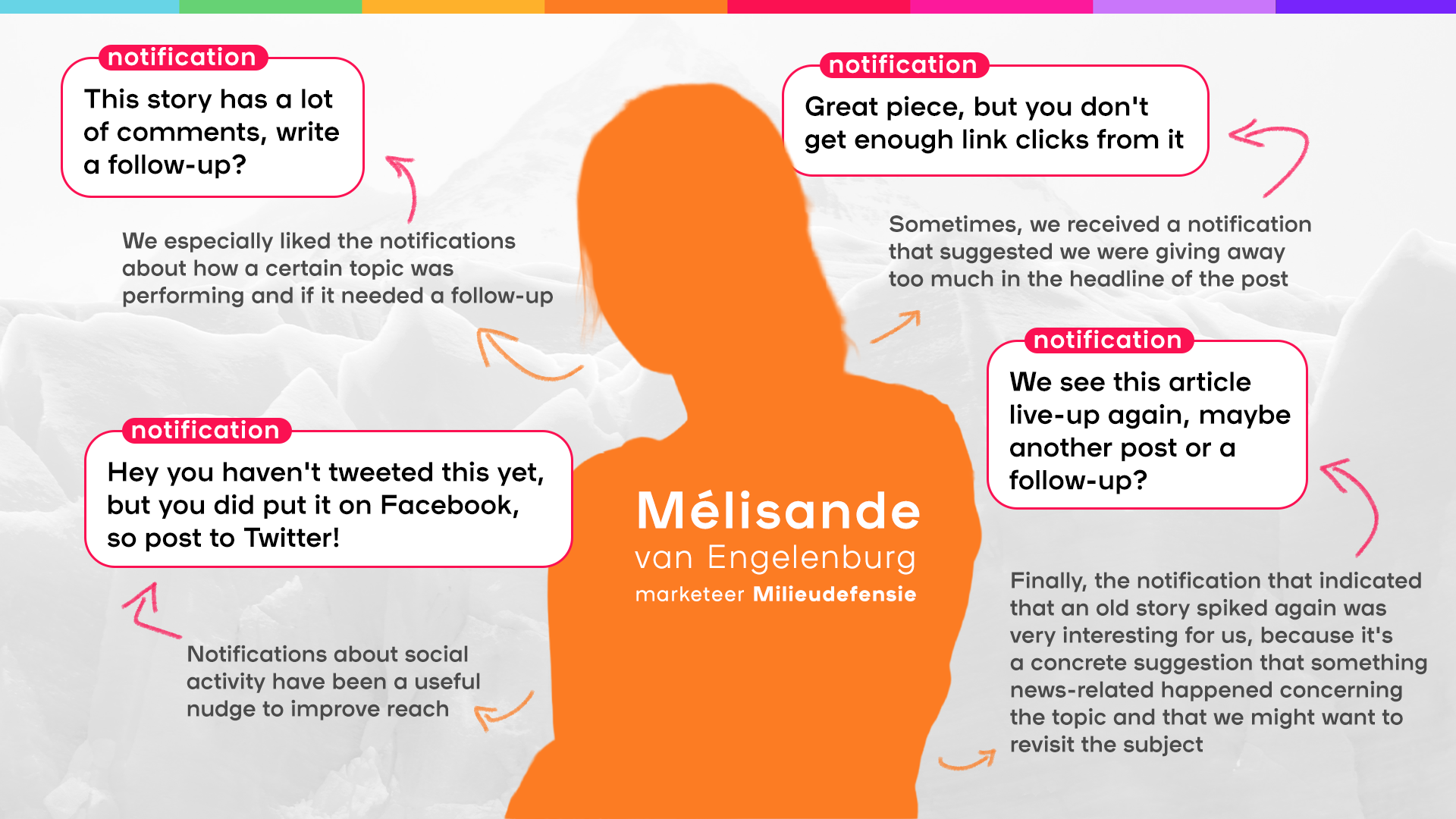
How smart notifications worked for Milieudefensie
- Tips were sent directly to their Trello board (where their content calendar lives), which meant that it was easy for everyone to access, but crucially also that it helped integrate this new feature/ service into the existing workflow
- Mélisande assumed a kind of triage role with notifications: weeding out less relevant tips, and ensuring that the most useful ones were dealt with. For example, there was a notification about the newsletter generating a lot of traffic, but because this wasn’t sent out often, any traffic uptick was a logical result of this event, and therefore this tip wasn’t worth spending time on.
- Donato notes that the only problem they faced was that they often lacked the capacity to follow up on the tips generated - which was why it was important for Mélisande to have oversight of them. Linked to this was the fact that they produced a lot less content than news publishers, so they had a corresponding lower amount of notifications in the first place. Donato was keen to point out that even taking this into consideration, the tips received were very helpful and served as a reminder to focus efforts carefully.
"The smart notifications give really precise information about which action to take"
What did Milidefensie learn from working with smartocto?
MÉLISANDE:
“Smartocto taught me to look much more at people's needs. To really ask yourself: What kind of needs does our audience have in terms of information? We now mainly serve informative needs, but we have to look more at other needs too. Smartocto really pushed me in that direction. We need to think about how to really connect our audiences’ needs to our stories. It’s just a matter of getting the whole organisation involved on this user needs model!”
DONATO:
“What we realised when working with smartocto, is that we really struggled with creating content and how much effort it took to really benefit from it. The biggest problem wasn’t monitoring smartocto, but rather adjusting our workflow in such a way that we could deal with the incoming notifications and insights. So, it would help if the notifications were able to be more concrete, for example: ‘If you share this post on Twitter, there's a chance that conversions to the petition page will increase by 2%’. With that kind of advice smartocto would become even more interesting for an organisation like ours.”
What did we (smartocto) learn from this?
“This experience of working with a non-journalistic company, helped us to develop our tools to fit content-strategy minded businesses even better”

Rutger Verhoeven CRO, smartocto
"We knew when we started the pilot with Milieudefensie that it would be a challenge to let them react to all the notifications the smart system would calculate. But we both believed that it was worth the challenge. I think we both learned a lot from this. We now know that putting the main focus of the tool on story performance isn’t necessarily the most beneficial approach for an NPOS and organisations like Milieudefensie. As they mentioned themselves they found that getting more insights on the impact a particular notification will have to be much more useful."
It was in part because of this experience that led us to develop smartify
- A smarter way of presenting the stories that would benefit from some kind of editorial action - and learn about the predicted impact that change will have.
We also created goals
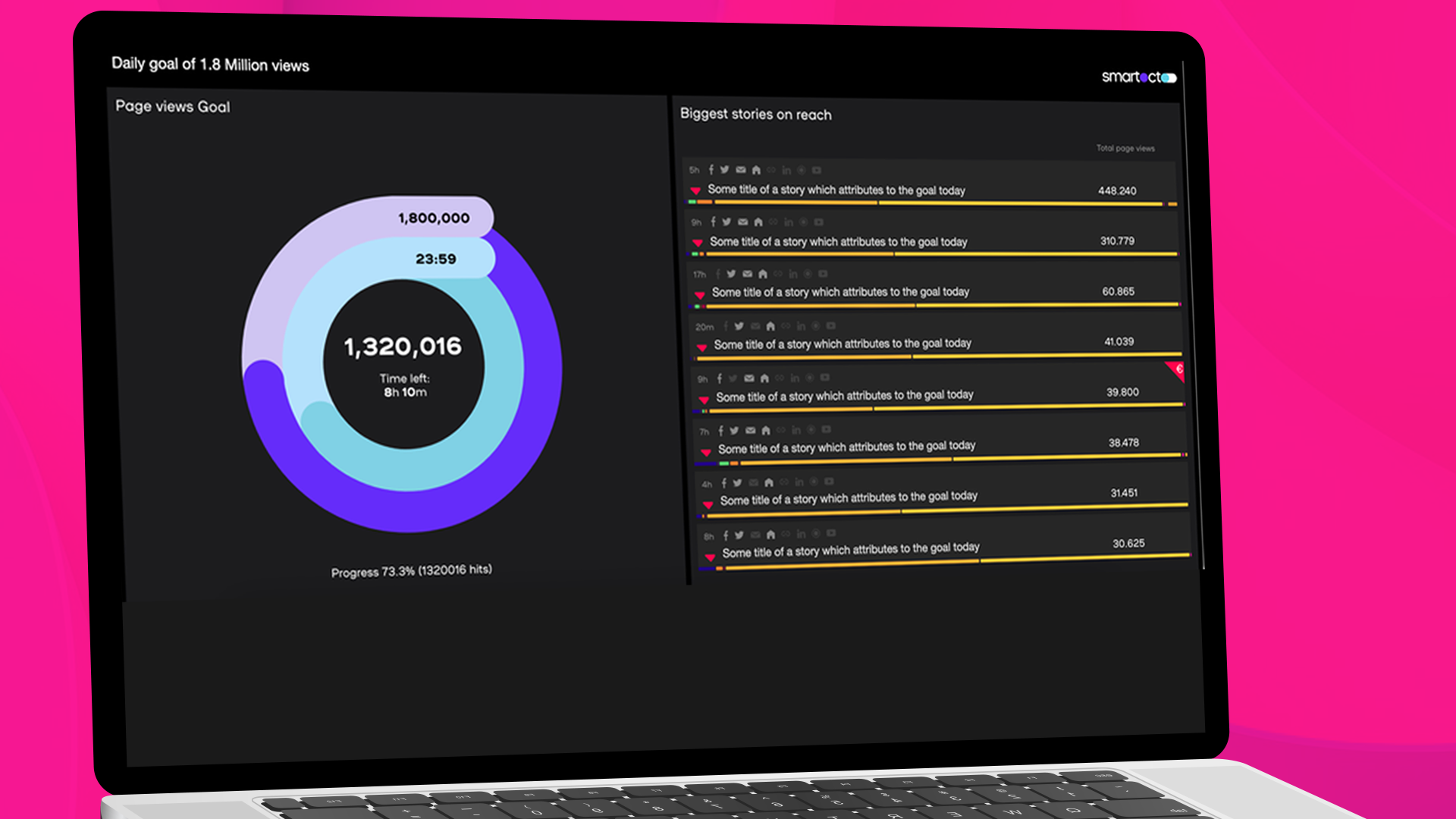
- Helps teams to visualise the thing they want to achieve - and the time they have to realise it. It shows you how close you are to reaching your specific goal and also alerts you (via notification) of actions you can take to accelerate that process.