Guidance for your articles that lives directly on your website

In recent years, an enormous number of tools, apps and features have entered the market, and many media organisations now use Artificial Intelligence to provide summaries or enhance search functions.

In developing AI Overlay, smartocto focused on two principles:

  1. There must be a connection with the website’s actual data, so the system understands what optimisation means for your specific site and strategy.
  2. The tool must sit in a place that aligns with the natural workflow of a newsroom.
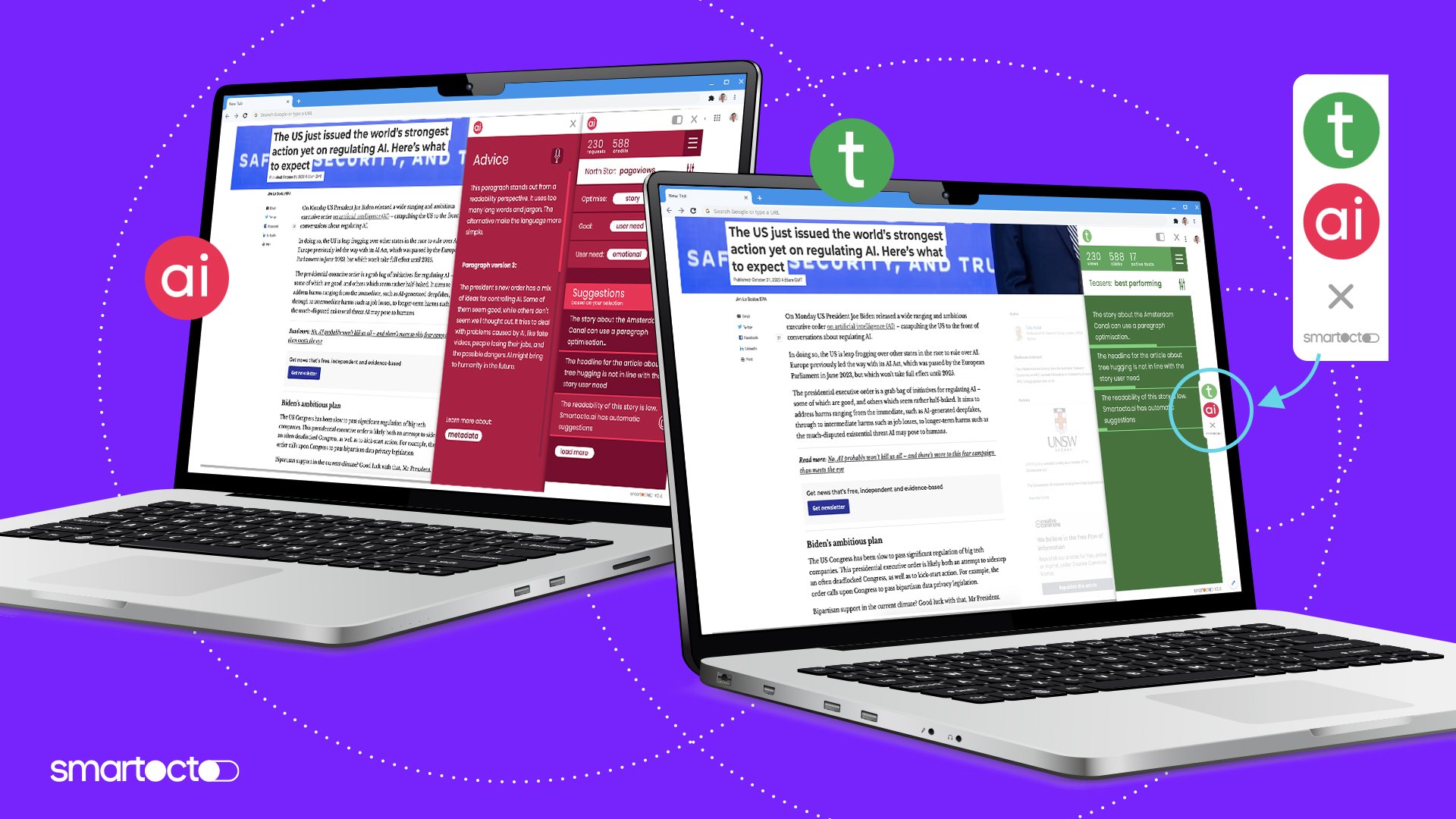
What can you do with AI Overlay?

See exactly at which paragraph readers drop off. In the overlay, you can indicate which paragraph you want to improve. The tool provides a readability score and offers three rewriting suggestions.

  1. Tentacles, our A/B testing tool, may reveal that an article placed at the top of the homepage is underperforming. In the overlay, you can call up headline suggestions.
  2. You can request an analysis of the metadata. The system then shows the key terms from the piece, which you can use for tagging or navigational purposes.
  3. You can request a sentiment score. This may reveal that you are portraying a particular city or politician in a more negative light than intended. It helps you view your content from a different perspective.
  4. You can optimise the publication time. The system calculates the moments at which the article is likely to perform well. This is especially useful for follow ups or for distribution via newsletters or social media.
  5. You can ask the system to think along with you about follow ups from a different audience need. If you have produced a purely factual report, the overlay may suggest a more context or emotion driven angle. These suggestions can sometimes be surprisingly insightful.

User needs tagger

The overlay is invaluable when you want to apply improvements at article level. Behind the scenes runs a system that is also capable of analysing large collections of articles.

That is the user needs tagger.

For each piece, we can identify and tag the dominant user need. As a rule, we work with the four user needs drivers (fact, context, emotion and action) although there is scope to expand this to the eight user needs defined in the User Needs Model 2.0, which we developed together with editorial strategist Dmitry Shishkin (ex-BBC).

Read more about user needs on our dedicated user needs page.

Solutions tailored to your sector

We can show you lots more features in a live demo - and answer any specific questions you have as well. Request your demo now or check out one of the packages we offer:

News
Brands
Sports
User needs
E-commerce
Academy

Check out the other features smartocto has to offer here